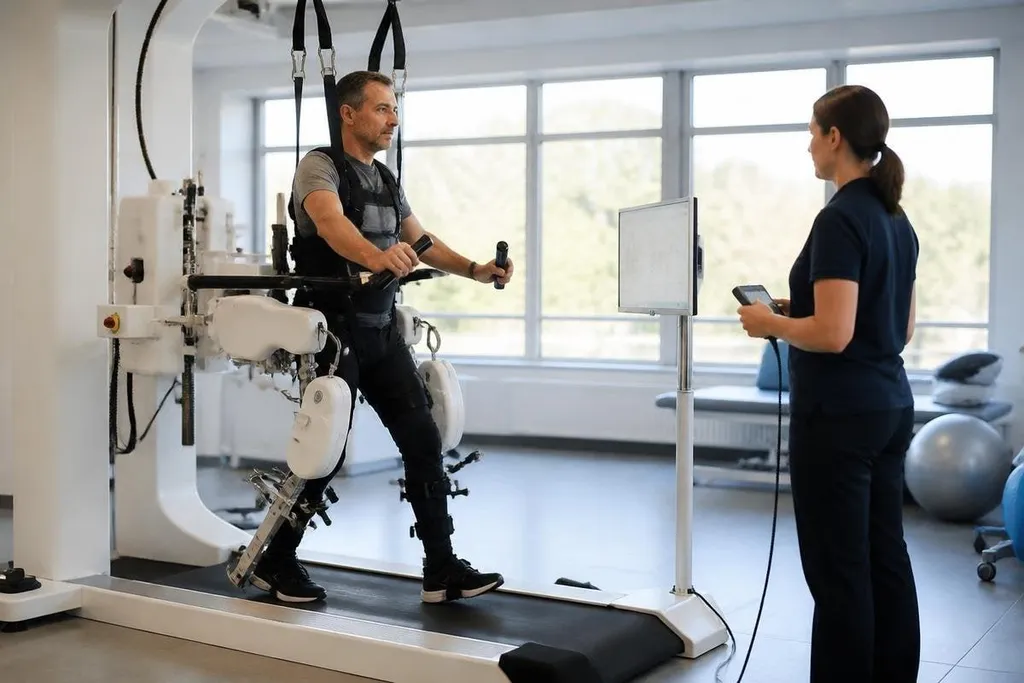
A rehabilitation robot can guide a patient through the same movement many times while recording how that movement changes. That makes it useful for walking practice, arm movement, hand control, and other tasks where steady repetition matters.
The machine doesn't replace a therapist. It changes how the therapist sets the task, measures movement, and adjusts the level of help.
- Repeated movement with a set amount of help
- Sensors that record force, position, or joint movement
- A clinic decision based on the patient’s task and progress
Where the robots fit
Rehabilitation robots come in several forms.
An exoskeleton supports the legs or arms from outside the body. A treadmill system can guide the legs during walking practice. A robotic arm can support the shoulder or elbow while a patient reaches for a target.
Hand devices take a smaller approach. They can help a patient open and close the fingers, hold an object, or repeat a grip-and-release task. The physical setup changes by body part, but the aim stays close: give the patient a task they can repeat with controlled assistance.
That assistance can change during a session. A robot may carry part of the limb’s weight, guide a joint along a set path, or resist movement so the patient has to work harder. The therapist decides which mode fits the person’s strength and control.
What the sensors add
Therapists can see whether a movement worked, but a robot can record details during each attempt. Position sensors can track joint angles. Force sensors can show how much the patient pushes or pulls. A system can also record how often the patient reaches a target or completes a step.
Those measurements give the next session a clearer starting point. If the patient moves with less help, reaches farther, or controls the limb with fewer corrections, the therapist has a record to review. A single score still can't describe recovery on its own, since comfort, balance, pain, and daily tasks matter too.
A lower assistance score can show progress during a session, yet it may say little about stairs, dressing, or walking at home. Reports at Robot24 that name the rehabilitation robot, task, and setting give that score context before a clinic treats it as proof of daily recovery.
The limits inside the clinic
More repetitions don't automatically mean better recovery. The task has to match the patient’s condition, and the therapist still needs to watch for pain, poor posture, fear, or movement that the robot is guiding rather than the patient.
A machine can also make a task look tidy while hiding a weak part of the movement. For example, a leg system may help lift the foot, but walking outside a clinic also demands balance, turning, stopping, and attention. A controlled session may not cover those demands.
Cost, setup time, staff training, and room size can shape the decision. A clinic needs space for the robot, time to fit the patient, and a plan for what happens when the system is unavailable. Those details affect daily care more than a product video does.
The evidence question also needs care. A clinic should ask which patient group was studied, what task the robot supported, how long treatment lasted, and which result was measured. A device tested for arm movement after stroke may not support a claim about walking after spinal injury.
A practical clinic check
Use these points before adding a rehabilitation robot to a treatment plan:
- Name the task. Choose walking, reaching, grip, balance, or another movement the patient needs in daily life.
- Set the patient’s role. Check whether the system guides the movement, carries part of the load, or adds resistance.
- Check the measure. Confirm what the robot records: joint position, force, repetitions, completion time, or another defined result.
- Plan the handoff. Pair robot practice with tasks that require balance, turning, handling objects, or moving without the device.
- Review the evidence. Match the study group and treatment length to the patient in front of you.
- Price the whole setup. Include fitting time, training, service, room space, and staff time alongside the purchase cost.
What happens next
The useful test is simple: can the robot give a patient more well-controlled practice without taking the therapist’s judgment out of the room? I'd choose the system that answers that question with measured task data, a clear fitting process, and a treatment plan that still works when the robot is switched off.